Dog Ear Ticks — AI Photo ID in 60s
Small unfed brown tick just attached (3mm)? Engorged grape-sized grey-blue tick after feeding? Embedded tick deep in canal (only legs visible)? Rule-out flea dirt (scattered black specks not whole insect)? Or ear mites coffee-ground debris (microscopic, no visible parasite)? Upload a close-up photo of your dog's ear — AI identifies the 5 most common tick patterns. Triage urgency + typical US vet cost. ⚠️ Embedded in canal, severe pain, signs of tick-borne disease (lethargy, fever) = same-day emergency.
Drop your pet's photo here
or
✅JPG, PNG, WEBP
📏Max 8MB
Educational AI pattern recognition only. Not a veterinary diagnosis. Always consult a licensed veterinarian for health concerns.
📸 Photo Guide
Good photos
- ✓Close-up, tick visible
- ✓Fur parted
Avoid
- ✗Too far away
- ✗Flash distorts color
Tips for best results
- ✓Get close-up — fill the frame with the tick and surrounding ear area
- ✓Part the fur around the tick if your dog is long-haired
- ✓Capture both the tick body and where it attaches to the skin
- ✓Use NATURAL DAYLIGHT — flash distorts tick color (unfed brown vs engorged grey-blue)
- ✓If multiple ticks, photograph each separately
- ✓Photograph BEFORE attempting any extraction — wrong technique leaves mouthparts behind causing secondary infection
- ✓⚠️ Emergency signs that mean skip the photo and go to a vet now: tick embedded deep in canal, severe pain, bleeding, signs of tick-borne disease (lethargy, fever, joint pain)
What This Dog Ear Ticks AI Tool Identifies
- ✓Dog ear ticks — engorged vs unfed vs embedded vs flea dirt vs mites debris visual identification
- ✓Ticks on dogs ears or tick in a dog's ear — single tick attachment pattern
- ✓Engorged tick on dog ear — grape-sized grey-blue body after several days of feeding (long attached)
- ✓Small unfed tick on dog ear — 3mm dark brown flat body just recently attached
- ✓Embedded ticks in dog ear or tick in dog ear canal — deep canal embedding (vet-only extraction)
- ✓Tick bite dog ear — distinct bite point + small redness + possible secondary infection signal
- ✓Tick on dog ear flap or tick on dog's ear flap — surface attachment, easier to identify
- ✓Ticks dogs ears pictures or pictures of ticks in dogs ears — visual identification reference patterns
- ✓Tick in dog ear symptoms or ticks in dogs ears symptoms — head shaking + scratching + visible insect on ear or in canal + tick on dog ear swollen bite point
- ✓My dog has a tick on his ear — common owner observation, visual confirmation pattern
- ✓Tick bite dog ear vs tick bite on dog ear — distinct attachment point identification with surrounding redness assessment
- ✓Dog tick ear extraction — vet workup needed because mouthparts left behind cause secondary bacterial infection and abscess formation
- ✓Ear ticks in dogs — common after outdoor exposure (hike, dog park, tall grass), single or multiple tick presentation patterns
- ✓Tick inside dog ear or tick in dog ear canal — deep canal location requiring vet sedation for safe extraction (not at home)
- ✓Tick on dog ear flap vs tick on dog's ear flap — surface attachment easier to identify than deep canal embedment
- ✓Ticks dog ear or tick dog ear — simple owner search pattern after spotting a single insect on the ear
- ✓Dog with multiple ticks after outdoor exposure — environmental exposure assessment and tick-borne disease screening
- ✓Tick-borne disease signs (Lyme, Ehrlichia, Anaplasmosis) in dogs after ear tick attachment — emergency assessment patterns
How It Works — Dog Ear Ticks AI Identification
1
Upload a Close-Up Tick Photo
Gently part the fur around the tick on your dog's ear. Take a close-up that shows tick size (small unfed = 3mm flat / engorged = grape-sized round), color (dark brown unfed / grey-blue engorged), and location (outer ear flap / inside canal opening / deep in canal). Natural daylight, no flash. Take the photo BEFORE attempting any extraction — vet extraction is safer (mouthparts left behind cause secondary infection).
2
AI Identifies the Pattern
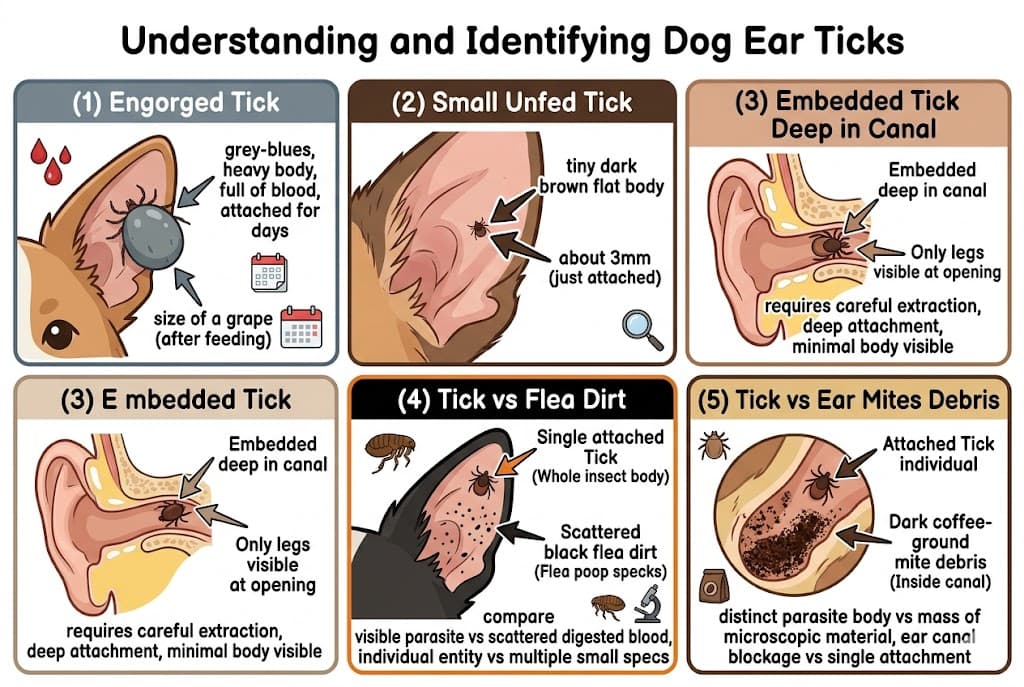
The AI compares your photo against 5 distinct dog ear ticks patterns: engorged tick (grape-sized grey-blue after feeding), small unfed tick (3mm dark brown just attached), embedded tick deep in canal, tick vs flea dirt (single insect vs scattered black specks), and tick vs ear mites debris (visible individual vs microscopic coffee-ground). Size, color, and location are analyzed.
3
Get Your Triage Report
Receive the most likely tick type, urgency level (vet within week → emergency), typical US vet visit cost estimate, and what to prepare. AI is educational pattern recognition — not a veterinary diagnosis. Vet extraction is the recommended path for ear ticks (mouthparts left behind cause secondary infection and tick-borne disease risk).
Dog Ear Ticks — Signal Triage
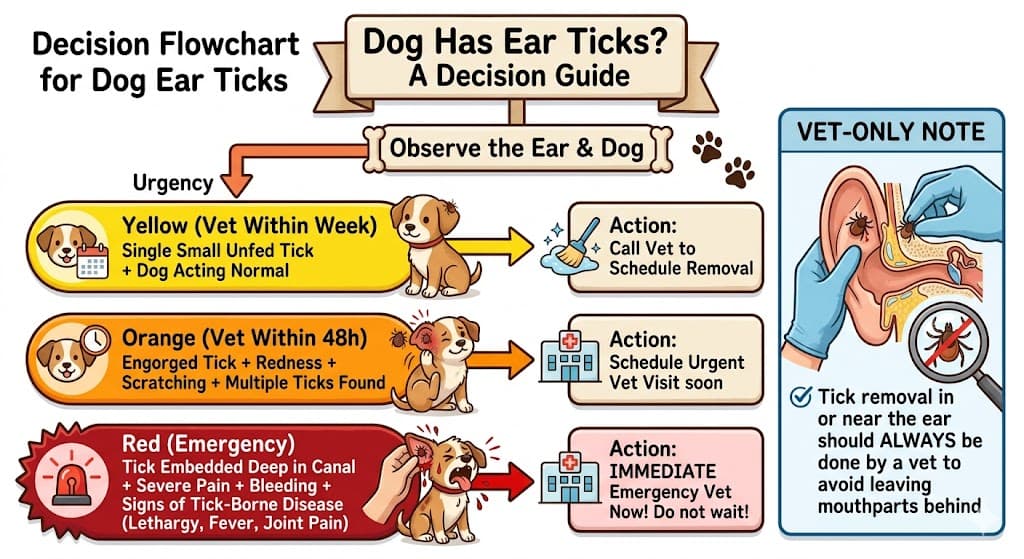
Dog ear ticks — match what you see to the most likely sub-type. Upload your dog's ear photo above for AI analysis that goes deeper than this table.
Single small dark brown flat tick (3mm) just attached on outer ear flap + dog acting normal
Recently attached small unfed tick — vet visit within 1 week for safe extraction (avoids mouthparts left behind)
Grape-sized grey-blue engorged tick on ear + tick has been attached for days + slight redness
Engorged tick after feeding — vet visit within 48h for safe extraction + tick-borne disease screening
Multiple ticks found on ears + dog scratching + redness + dog spending time outdoors recently
Multiple tick infestation — vet visit within 48h; environmental tick exposure assessment needed
Only legs or partial body visible at canal opening + tick body deep inside canal + pain
Embedded tick deep in ear canal — emergency vet today; deep canal ticks require sedation for safe vet extraction
Dog lethargic + fever + joint pain + appetite loss + recent tick exposure
Possible tick-borne disease (Lyme, Ehrlichia, Anaplasmosis) — emergency vet today for bloodwork
Dog Ear Ticks — Visual Reference Patterns
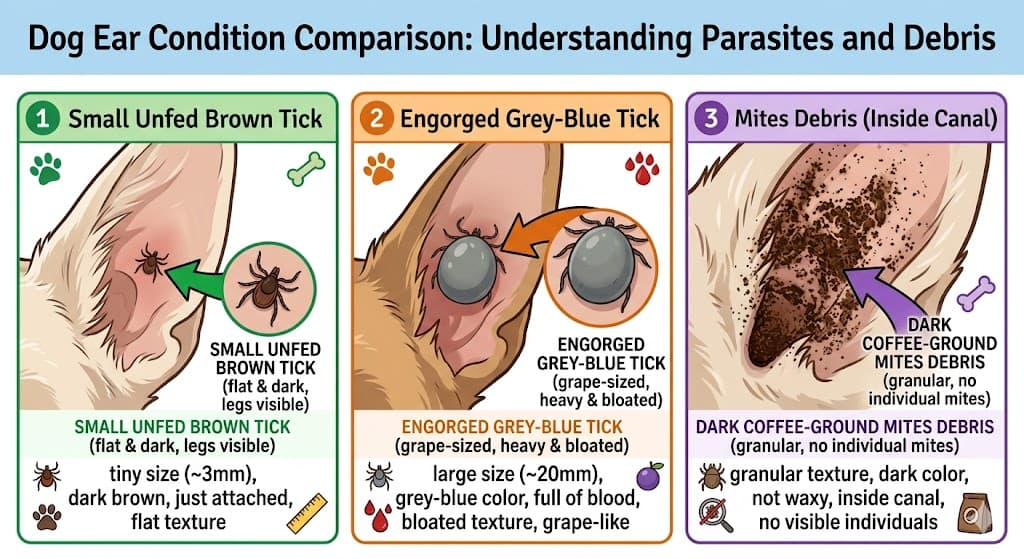
Compare what you see on your dog's ear to the 5 most common tick patterns. Upload your dog's ear photo above for AI analysis specific to your dog.
Dog Ear Ticks — When to See a Vet?
Dog ear ticks that's small unfed brown, engorged grey-blue, embedded deep in canal, or rule-out flea dirt vs mites debris? Upload a photo of your dog's ear — AI identifies the tick type, tells you when to see a vet for safe extraction, and gives a typical US vet cost estimate.
Upload Your Dog's Ear Photo Now →Educational Disclaimer
Yipara provides AI-generated preliminary, educational pattern recognition for informational purposes only. This tool is NOT a veterinary diagnosis and is NOT a substitute for professional veterinary advice, examination, or treatment. The AI analysis has inherent limitations and may produce inaccurate results. Always consult a qualified, licensed veterinarian with any questions regarding your pet's health. Never disregard professional veterinary advice or delay seeking it because of information provided by this tool. If your pet is experiencing a health emergency, contact your veterinarian or emergency animal hospital immediately.
Frequently Asked Questions
How to tell if a tick is in a dog's ear? Or how long can a tick stay in a dog's ear?
+
How to tell if a tick is in a dog's ear: look for a single small insect (3mm dark brown if unfed, grape-sized grey-blue if engorged) attached to the ear flap, inside the canal opening, or sometimes hidden deep in the canal where only legs are visible. Beyond the visible insect: head shaking, scratching the ear, small swelling at the bite point (tick on dog ear swollen bite area), and sometimes a small red dot or blood smear where the tick is feeding. How long can a tick stay in a dog's ear: ticks typically attach and feed for 3-7 days before becoming fully engorged and dropping off naturally, but during that time they can transmit tick-borne diseases (Lyme, Ehrlichia, Anaplasmosis), cause secondary bacterial infection at the bite point, or migrate deeper into the canal causing eardrum damage. The longer the tick stays attached, the higher the disease transmission risk — vet extraction within 24-48 hours of spotting the tick is the safest path.
My dog has a tick on his ear — should I try to take it off myself?
+
Dog ear ticks should generally be taken off by a vet, not at home. The ear has thin skin and many small blood vessels; wrong extraction technique commonly leaves the tick mouthparts behind, which causes secondary bacterial infection, abscess formation, and prolonged inflammation. Inside-canal ticks are especially risky — they require sedation for safe extraction. The vet can also do tick-borne disease screening (Lyme, Ehrlichia, Anaplasmosis blood test) at the same visit. If you absolutely cannot get to a vet, [VCA Hospitals' guide to ticks in dogs](https://vcahospitals.com/know-your-pet/ticks-in-dogs) walks through proper fine-pointed tweezers technique, but expect to follow up with a vet to check for retained mouthparts and infection.
Tick in dog ear symptoms — what should I watch for?
+
Tick in dog ear symptoms beyond the visible tick: persistent head shaking (the tick is irritating the canal); scratching the affected ear; small bite point with surrounding redness; sometimes a small swelling around the bite if the tick has been attached for days; possible secondary infection signs (discharge, foul smell) if mouthparts are retained from a previous improper extraction. Concerning systemic signs that suggest possible tick-borne disease (Lyme, Ehrlichia, Anaplasmosis): lethargy, fever, appetite loss, joint pain or lameness, swollen lymph nodes, sudden bleeding tendency. These systemic signs appear 1-4 weeks after tick attachment and need emergency vet visit for bloodwork.
Embedded ticks in dog ear or tick in dog ear canal — emergency?
+
Embedded ticks in dog ear or tick in dog ear canal where the tick body is deep inside (only legs visible at opening, or completely hidden) is a vet emergency, not a watch-at-home situation. Reasons: (1) inside-canal ticks cannot be safely extracted without sedation — attempting it awake causes severe pain and ear canal trauma; (2) leaving the tick in place lets it continue feeding and increases tick-borne disease transmission risk; (3) the tick may have moved to the eardrum area and could perforate the eardrum if disturbed by wrong extraction. Same-day vet visit needed. The vet will use otoscope visualization + sedation + fine-pointed tweezers or special tick extraction tools to extract the whole tick including mouthparts.
Tick on dog ear vs flea dirt vs ear mites — how to tell the difference?
+
Tick on dog ear is a single (or several) visible whole insect — about 3mm dark brown when unfed, growing to grape-sized grey-blue when engorged after days of feeding. You can see the body, legs, and bite point clearly. Flea dirt is small black specks (flea poop) scattered across the ear skin, NOT individual whole insects — when you wet a black speck with water it leaves a red-brown stain (digested blood). Ear mites debris (Otodectes) is dark coffee-ground texture deep inside the ear canal, NOT individual visible parasites — the mites themselves are microscopic and not visible without a microscope, only the debris they leave behind. The key distinction: tick = whole visible insect on ear; flea dirt = scattered black specks; mites = dark debris with no visible parasite. Pictures of ticks in dogs ears show single insects; mites photos show only debris.
My dog spent time outdoors and now there are ticks on dogs ears — what now?
+
When ticks on dogs ears appear after outdoor exposure (hike, dog park, tall grass, wooded area), the priority is safe vet extraction of all visible ticks + checking for ticks in other body areas dogs commonly miss (between toes, armpits, groin, around the tail base). Multiple ticks suggest heavier environmental exposure and higher tick-borne disease risk. Even if you only see 1 tick on the ear, ask the vet to check the whole dog. Vet may also recommend tick-borne disease screening 2-4 weeks after exposure (blood test for Lyme / Ehrlichia / Anaplasmosis antibodies) and discuss prevention going forward. Environmental control: avoid known tick areas during peak tick season (spring-fall in most US regions), check the dog after every outdoor session.
Pictures of ticks in dogs ears — what should I look for?
+
Pictures of ticks in dogs ears show several distinct visual patterns. Small unfed tick: about 3mm flat dark brown body with 8 visible legs, just attached, may look like a small mole or skin tag at first glance until you look closely. Engorged tick (attached for 2-7 days): body has swelled to grape-sized round shape, color shifts from dark brown to grey-blue as it fills with blood, legs may not be visible if body is very swollen. Embedded tick: only legs visible at the canal opening, or just a small bump where the tick has burrowed in. Bite point after extraction: small red dot with possible surrounding swelling. Images of ticks in dogs ears for visual reference are useful for distinguishing tick from skin tag (skin tag has no legs and doesn't grow over days) and tick from flea dirt (single whole insect vs scattered black specks). [PetMD's tick identification guide](https://www.petmd.com/dog/conditions/parasitic/c_dg_ticks) walks through visual differentiation of common tick species in the US.
Related Dog Ear Reading
Deeper guidance on dog ear parasites and related ear conditions — written for dog owners trying to make sense of what they see.
Black Stuff in Dogs Ear — Mites vs Yeast vs Wax
If you see dark coffee-ground debris inside the canal without a visible whole insect, the cause is ear mites (Otodectes) not ticks. Identification tool for the dark debris.
Read more →
Ear Mites in Dogs — Symptoms, Causes, Vet Guide
Full guide to ear mites Otodectes — the microscopic parasite that leaves coffee-ground debris (different from visible ticks).
Read more →
Scabs on Dogs Ears — Dry Healed vs Infected vs Mites vs Hot Spot
After tick extraction, the bite point may form a small scab. Identification tool for distinguishing recovering scab from secondary infection scab.
Read more →
As an Amazon Associate, Yipara earns from qualifying purchases — at no extra cost to you. How we handle partner links.
💡Recommended for this concern
🐾Pet care essentials worth keeping at home
More ways to check your pet
Eyes
Dogs & CatsRed, watery, cloudy, or squinting eyes? See if it's something to watch or act on.
⭐ Most Popular
Skin & coat
Dogs & CatsItchy, red, scabby, or losing fur? See if it's something to watch or act on.
Dog ears
Dogs OnlyScratching, head-shaking, or smelly ears? See if it's something to watch or act on.
Cat ears
Cats OnlyScratching, dark wax, or head-shaking? See if it's something to watch or act on.
Cat vomiting
Cats OnlyThrowing up foam, food, or bile? See if it's something to watch or act on.
Dog vomiting
Dogs OnlyThrowing up foam, bile, or food? See if it's something to watch or act on.
Dog nose
Dogs OnlyDry, cracked, crusty, or runny nose? See if it's something to watch or act on.
Dog teeth & gums
Dogs OnlyBad breath, tartar, or red gums? See if it's something to watch or act on.
Dog poop
Dogs OnlyBlood, mucus, worms, or runny stool? See if it's something to watch or act on.
Dog lumps & bumps
Dogs OnlyFound a new lump or bump? See if it's something to watch or act on.
Dog wounds
Dogs OnlyA cut, scrape, or wound that looks off? See if it's something to watch or act on.
Dog bug ID
Dogs OnlyFound a bug, flea, or tick on your dog? See if it's something to watch or act on.
Dog paws
Dogs OnlyLimping, licking, or swollen paws? See if it's something to watch or act on.
Cat pee
Cats OnlyBlood, dark, or cloudy urine? See if it's something to watch or act on.
Dog pee
Dogs OnlyBlood, dark, or orange urine? See if it's something to watch or act on.
Dog gums & tongue
Dogs OnlyPale, blue, yellow, or off-color gums? See if it's something to watch or act on.
Cat hair loss
Cats OnlyBald patches, thinning, or over-grooming? See if it's something to watch or act on.
Cat eye discharge
Cats OnlyWatery, green, yellow, or crusty eyes? See if it's something to watch or act on.
Cat sneezing + eye discharge
Cats OnlySneezing + watery, yellow, or green eyes? See if it's something to watch or act on.
Severe dog ear wax
Dogs OnlyBrown chunky wax, pus, or black mite debris? See if it's something to watch or act on.
Cat ear infection pictures
Cats OnlyYellow-green pus, brown chunky, or black debris? See if it's something to watch or act on.
Dog hot spots pictures
Dogs OnlyRed moist patch that appeared in hours? See if it's something to watch or act on.
Dog tail lump pictures
Dogs OnlyLump on the tail — cyst, lipoma, or concerning? See if it's something to watch or act on.
Cat paw infection pictures
Cats OnlyPus, brown greasy, or sudden swollen paw? See if it's something to watch or act on.
Dog ear yeast infection pictures
Dogs OnlyBrown chunky wax with sweet musty smell? See if it's something to watch or act on.
Black stuff in dogs ear
Dogs OnlyDark gritty debris, greasy brown, or pus inside ear? See if it's something to watch or act on.
Brown discharge dog ear infection
Dogs OnlyGreasy brown discharge, yellow pus, or thick gunk in ear? See if it's something to watch or act on.
Bump on dogs ear
Dogs OnlySoft cyst, cauliflower wart, red pimple, or firm polyp? See if it's something to watch or act on.
Scabs on dogs ears
Dogs OnlyDry healed, red infected with pus, or mites scratch scab? See if it's something to watch or act on.
Crusty dog ears
Dogs OnlyYellow bacterial, brown yeast, or pinnal margin edge crust? See if it's something to watch or act on.
Dry dog ears
Dogs OnlySenior aging, yeast chronic, seborrhea, winter or allergy? See if it's something to watch or act on.
Cat acne pictures
Cats OnlyBlackheads, cystic bumps, or chin mites? See if it's something to watch or act on.
Dog skin diseases pictures
Dogs OnlyAllergic, bacterial, mange, ringworm, or hot spot? See if it's something to watch or act on.
Dog skin tags pictures
Dogs OnlySkin tag, tick mimic, wart, or cyst? See if it's something to watch or act on.
Dog skin infection pictures
Dogs OnlyBacterial, yeast, fungal ringworm, or hot spot? See if it's something to watch or act on.
Dog belly rash pictures
Dogs OnlyAllergy, flea, yeast in folds, or bacterial? See if it's something to watch or act on.
Hyperkeratosis dog paw
Dogs OnlyCrusty pad edges, callus, pemphigus, or burn? See if it's something to watch or act on.
Dog paw yeast pictures
Dogs OnlyRust staining, corn-chip smell, bacterial, or cyst? See if it's something to watch or act on.
Hyperkeratosis cat paw
Cats OnlyCrusty pad edge, horned paw, pemphigus, or burn? See if it's something to watch or act on.
Cherry eye in cats
Cats OnlyRed rounded mass at inner eye corner? See if it's something to watch or act on.
Cat eye infection pictures
Cats OnlyRed eye, pus, watery, or single-eye discharge? See if it's something to watch or act on.
Cat cloudy eye
Cats OnlyCataract, nuclear sclerosis aging, or uveitis? See if it's something to watch or act on.
Dog ringworm pictures
Dogs OnlyCircular bald patch with scaly edge? See if it's something to watch or act on.
Dog skin black spots pictures
Dogs OnlyFlea dirt, comedones, hyperpigmentation, or Cushing's? See if it's something to watch or act on.
Dog skin scabs pictures
Dogs OnlyHot spot, allergy, mange, FAD, or injury scab? See if it's something to watch or act on.
Dog skin rash pictures
Dogs OnlyHives, atopic, food allergy, FAD, or contact rash? See if it's something to watch or act on.
Dog skin mites pictures
Dogs OnlySarcoptic, Demodex, ear mites, or Cheyletiella? See if it's something to watch or act on.
Cat skin conditions pictures
Cats OnlyAtopic, miliary, eosinophilic, ringworm, or abscess? See if it's something to watch or act on.
Cat skin tag pictures
Cats OnlySkin tag vs nipple vs tick vs wart vs cyst? See if it's something to watch or act on.
Cat skin infection pictures
Cats OnlyBacterial, fungal, yeast, mite, or scratch wound? See if it's something to watch or act on.
Cat black spots on skin
Cats OnlyLentigo vs flea dirt vs acne vs mange vs growth? See if it's something to watch or act on.
Cat skin rash pictures
Cats OnlyAllergic, FAD, fungal, miliary, or severe? See if it's something to watch or act on.
Cat skin mites pictures
Cats OnlyNotoedric, Cheyletiella, Demodex, or harvest? See if it's something to watch or act on.
Cat ringworm pictures
Cats OnlyEarly stage, classic ring, spreading, or mistaken-for? See if it's something to watch or act on.
Dog eye discharge
Dogs OnlyGreen, yellow, brown, or watery eye goop? See if it's something to watch or act on.
Dog nails
Dogs OnlyA broken, bleeding, or torn nail? See if it's something to watch or act on.
Dog weight
Dogs OnlyOverweight, underweight, or just right? See if it's something to watch or act on.
Cat weight
Cats OnlyOverweight, underweight, or just a pouch? See if it's something to watch or act on.
Dog hair loss
Dogs OnlyBald spots, patches, or thinning fur? See if it's something to watch or act on.
Cat gums & tongue
Cats OnlyPale, blue, yellow, or red gums? See if it's something to watch or act on.
Dog acne
Dogs OnlyPimples or bumps on the chin or muzzle? See if it's something to watch or act on.
Cat acne
Cats OnlyBlack specks or bumps on the chin? See if it's something to watch or act on.
Cat paws
Cats OnlySwollen, puffy, or sore paws? See if it's something to watch or act on.
Cat wounds
Cats OnlyA cut, scrape, or wound that looks off? See if it's something to watch or act on.
Cat bug ID
Cats OnlyFound a bug, flea, or tick on your cat? See if it's something to watch or act on.
Cat teeth & gums
Cats OnlyBad breath, drooling, or red gums? See if it's something to watch or act on.
Cat poop
Cats OnlyBlood, mucus, worms, or runny stool? See if it's something to watch or act on.
Cat lumps & bumps
Cats OnlyFound a new lump or bump? See if it's something to watch or act on.
Cat nose
Cats OnlyCrusty, runny, or discolored nose? See if it's something to watch or act on.

View all checks
See everything Yipara can help you check