Hyperkeratosis Dog Paw — AI Photo ID in 60s
Thickened crusty growth on your dog paw pad edges with deep cracks? Or smooth normal old-dog callus? Or peeled scales exposing pink raw skin (pemphigus pattern)? Or red-brown patches from chemical or thermal burn? Upload a close-up photo — AI identifies the 5 most common dog paw pad patterns. Triage urgency plus typical US vet visit cost. ⚠️ Peeled skin exposing raw flesh or heavy bleeding from cracks = same-day vet visit.
Drop your pet's photo here
or
✅JPG, PNG, WEBP
📏Max 8MB
Educational AI pattern recognition only. Not a veterinary diagnosis. Always consult a licensed veterinarian for health concerns.
📸 Photo Guide
Good photos
- ✓Close-up, texture visible
- ✓Peel pattern visible
Avoid
- ✗Too far away
- ✗Flash distorts color
Tips for best results
- ✓Get close-up — fill the frame with the pad surface
- ✓Flip the paw so the pad faces the camera squarely
- ✓Capture the entire pad including the front edge where hyperkeratosis growth usually appears
- ✓Use NATURAL DAYLIGHT — flash distorts texture and color
- ✓Photograph the worst-affected paw plus a healthy paw for comparison if possible
- ✓If you see peeled skin exposing pink raw flesh, photograph BEFORE any cleaning attempt
- ✓Skip the photo and head to a vet now: severe bleeding, dog cannot bear weight, peeled scales over large area, raw exposed flesh
What This Hyperkeratosis Dog Paw AI Tool Identifies
- ✓Hyperkeratosis dog paw — 5 sub-type identification: mild dry pad vs chronic hyperkeratosis crusty growth vs normal old-dog callus vs pemphigus foliaceus vs chemical burn
- ✓Dog paw hyperkeratosis — thickened crusty growth on the front edge of paw pads, often with deep cracks visible
- ✓Hyperkeratosis corn on dog paw pad — focal thickened crusty area resembling a corn, distinct from broader hyperkeratosis
- ✓Hyperkeratosis dog paw pictures — visual reference for owner comparison before vet visit
- ✓Nasal digital hyperkeratosis dog — same condition can affect the nose and paw pads together
- ✓Dog paw pad hyperkeratosis vs callus — hyperkeratosis grows on pad edges with crusty texture, normal callus stays smooth and central
- ✓Cracked dog paw pictures — distinguishes simple environmental cracks from hyperkeratosis chronic cracks
- ✓Dog paw pad peeling — peeled scales exposing pink raw skin underneath suggests pemphigus foliaceus autoimmune pattern, vet referral needed
- ✓Dog paw pads dry — mild surface dryness without cracks is environmental, with cracks and thickened edges is hyperkeratosis
- ✓Callus on dog paw pad — smooth dark hard center area in older dogs is normal callus, no vet visit needed unless cracking starts
- ✓Pemphigus foliaceus dog paw — autoimmune blistering condition causing scales and crusts on paw pads, vet diagnosis with biopsy
- ✓Dog paw pad burn pictures — red-brown patches and darkened spots from hot pavement, salt damage, or chemical irritation
- ✓Dog paw chemical burn pictures — surface damage from contact with cleaning chemicals or ice-melt salts
- ✓Dog paw pad ripped pictures — distinct from hyperkeratosis cracks, ripped pad is an acute injury needing vet care
- ✓Damaged dog paw pad pictures — covers full range from mild scrapes to deep hyperkeratosis cracks
- ✓Dog paw pad keratosis — broader term covering all keratin-related pad disorders including hyperkeratosis
- ✓Paw pad disease dog — vet-aligned identification of which pad condition is present before assuming a generic skin issue
- ✓Dog paw callus vs hyperkeratosis — most-confused look-alike pair, page main use-case is distinguishing these two visually
- ✓Dog licking paws or dog constantly licking paws or dog chewing paws or dog keeps licking paw — separate behavior question from pad hyperkeratosis. If your dog also constantly licks paws and you ask why is my dog licking his paws, see the companion guide on dog paw licking causes. A dog paw cleaner is a common owner search but vet diagnosis of the underlying pad pattern comes first.
How It Works — Hyperkeratosis Dog Paw AI Identification
1
Upload a Close-Up Dog Paw Pad Photo
Gently flip your dog onto its side or back so the pads face up. Take a close-up that shows pad surface texture (smooth normal / hard thickened / cracked deep / peeled exposing raw skin / red-brown burn-damaged), pad edges (smooth normal / crusty growth = hyperkeratosis), and any visible cracks, peels, or color changes. Natural daylight, no flash.
2
AI Compares Against 5 Sub-Types
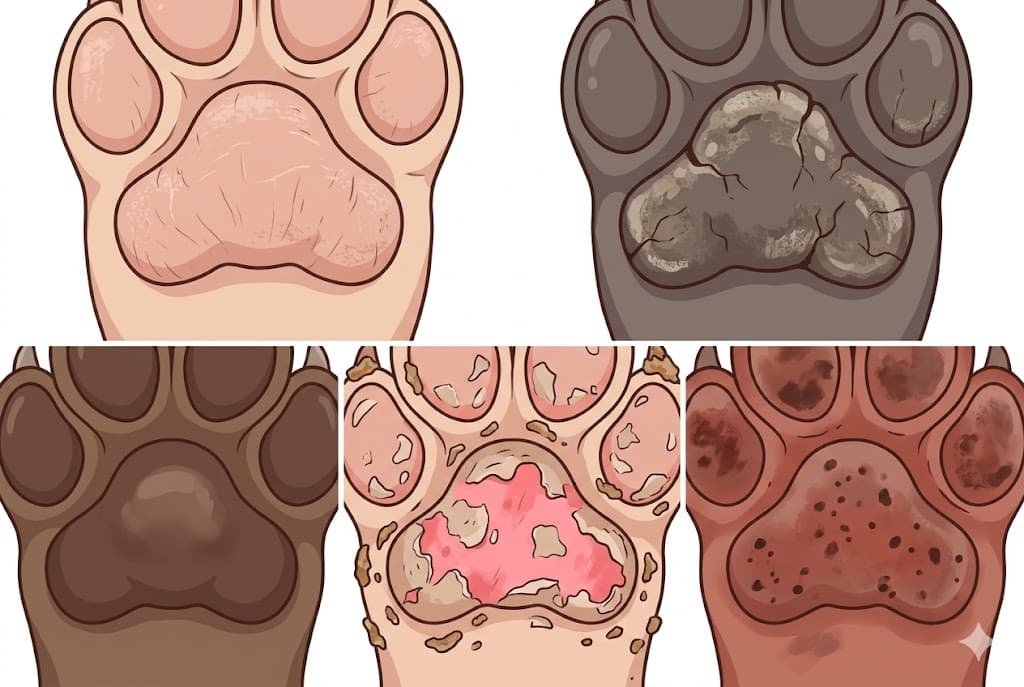
The AI compares your photo against 5 distinct dog paw pad patterns: mild dry pad (light surface dryness no cracks), chronic hyperkeratosis (thickened crusty growth on pad front edge with deep cracks), normal old-dog callus (smooth dark hard center no growth on edges), pemphigus foliaceus (peeled scales exposing pink raw skin scattered crusts autoimmune), and chemical or burn irritation (red-brown patches darkened spots surface damage).
3
Get Your Triage Report
Receive the most likely pad sub-type, urgency level (watch at home through same-day emergency), typical US vet visit cost estimate, and what to prepare for the appointment. AI is educational pattern recognition — not a veterinary diagnosis. Persistent hyperkeratosis, pemphigus patterns, and chemical burns all belong in front of a vet for definitive diagnosis.
Hyperkeratosis Dog Paw — Signal Triage
Hyperkeratosis dog paw — match what you see to the most likely sub-type. Upload your dog paw photo above for AI analysis that goes deeper than this table.
Light pink-tan paw pad with slight surface dryness, no cracks, no thickening, dog acting normal
Mild dry pad (environmental) — watch at home, gentle moisturizing care if your vet has previously recommended a product
Smooth dark hard center area on paw pad, no cracks, no growth on edges, older dog
Normal old-dog callus — watch at home, no action needed unless cracking starts later
Thickened crusty growth on the front edge of paw pad with visible deep cracks, dog occasionally limps
Chronic hyperkeratosis — vet visit within a week for trim-and-debride workup and underlying cause check
Peeled-off scales exposing pink raw skin underneath, scattered crusts on multiple pads, dog uncomfortable
Possible pemphigus foliaceus autoimmune pattern — vet visit within 48 hours for biopsy and definitive diagnosis
Red-brown patches with darkened spots, surface damage, recent exposure to hot pavement, salt, or chemical, dog licking constantly
Chemical or thermal burn — vet visit within 48 hours for proper pad-care plan and infection check
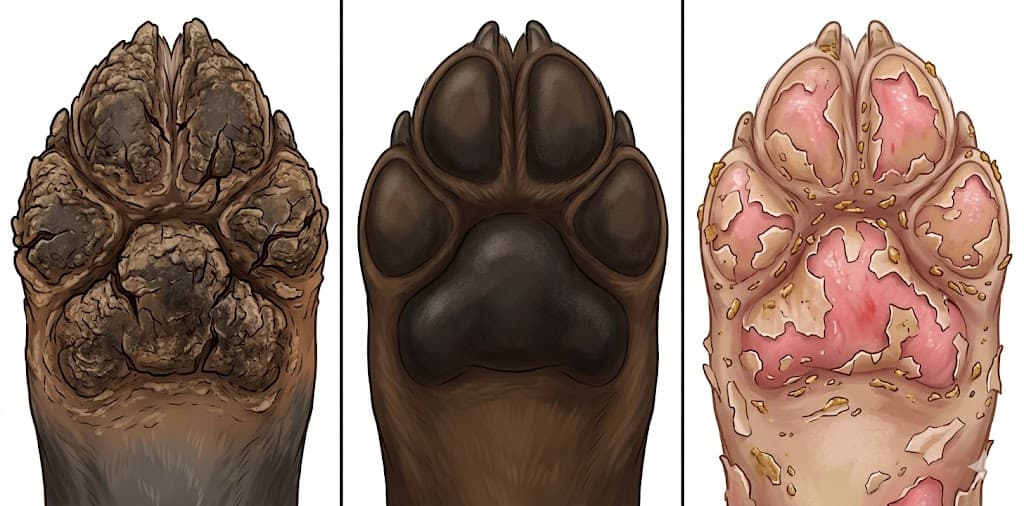
Hyperkeratosis Dog Paw — Visual Reference Patterns
Compare what you see on your dog paw to the 5 most common pad sub-types. Upload your dog paw photo above for AI analysis specific to your dog.
Hyperkeratosis Dog Paw — When to See a Vet?
Dog paw pad that is mild dry, chronic hyperkeratosis crusty, normal callus, pemphigus peeled, or chemical burn damaged? Upload a photo of your dog paw — AI identifies the pad sub-type, tells you when to see a vet, and gives a typical US vet cost estimate.
Upload Your Dog Paw Photo Now →Educational Disclaimer
Yipara provides AI-generated preliminary, educational pattern recognition for informational purposes only. This tool is NOT a veterinary diagnosis and is NOT a substitute for professional veterinary advice, examination, or treatment. The AI analysis has inherent limitations and may produce inaccurate results. Always consult a qualified, licensed veterinarian with any questions regarding your pet's health. Never disregard professional veterinary advice or delay seeking it because of information provided by this tool. If your pet is experiencing a health emergency, contact your veterinarian or emergency animal hospital immediately.
Frequently Asked Questions
What does hyperkeratosis on a dog paw look like?
+
Hyperkeratosis on a dog paw shows up as thickened crusty growth on the front edge of the paw pads, often with deep cracks visible across the pad surface. The texture is hard and dry, distinct from the smooth dark normal callus that older dogs naturally develop in the center of pads. Most cases show on the front edge of multiple pads at once. The AI tool above compares your photo against this exact pattern plus 4 other look-alikes.
Hyperkeratosis dog paw vs callus — how to tell them apart?
+
Hyperkeratosis grows on the front edges of paw pads with crusty thickened texture and visible cracks, often on multiple pads. Normal old-dog callus stays smooth and central on each pad with no cracks and no edge growth — it is hard but smooth, not crusty. Hyperkeratosis can also affect the nose at the same time (nasal digital hyperkeratosis pattern), while normal callus does not. If you see edge growth with cracks, lean toward hyperkeratosis; if you see only a smooth central hard area, lean toward normal callus.
Why does my dog have peeled skin on the paw pad with pink raw skin underneath?
+
Peeled scales exposing pink raw skin underneath on dog paw pads is suspicious for pemphigus foliaceus, an autoimmune skin condition that affects paw pads, nose, and occasionally ears. It needs a vet biopsy for definitive diagnosis — pemphigus is not the same as hyperkeratosis even though both show pad surface changes. A vet visit within 48 hours is the right move because pemphigus needs immune-modulating care plans, not generic moisturizers, and the longer it goes the more areas it affects.
Can chemical burns from ice melt or hot pavement look like hyperkeratosis?
+
Yes — chemical and thermal pad damage can look superficially similar to hyperkeratosis at first glance because both show pad surface changes. The differentiation: hyperkeratosis is chronic gradual buildup on pad edges, while chemical or thermal burns are sudden onset with red-brown patches, darkened spots, and a clear history of recent exposure (hot pavement walk, salt-treated sidewalk, contact with cleaning chemical). If the changes appeared within hours of an exposure event, lean toward burn; if it has been gradual over months, lean toward hyperkeratosis.
When should I see a vet for hyperkeratosis dog paw pad?
+
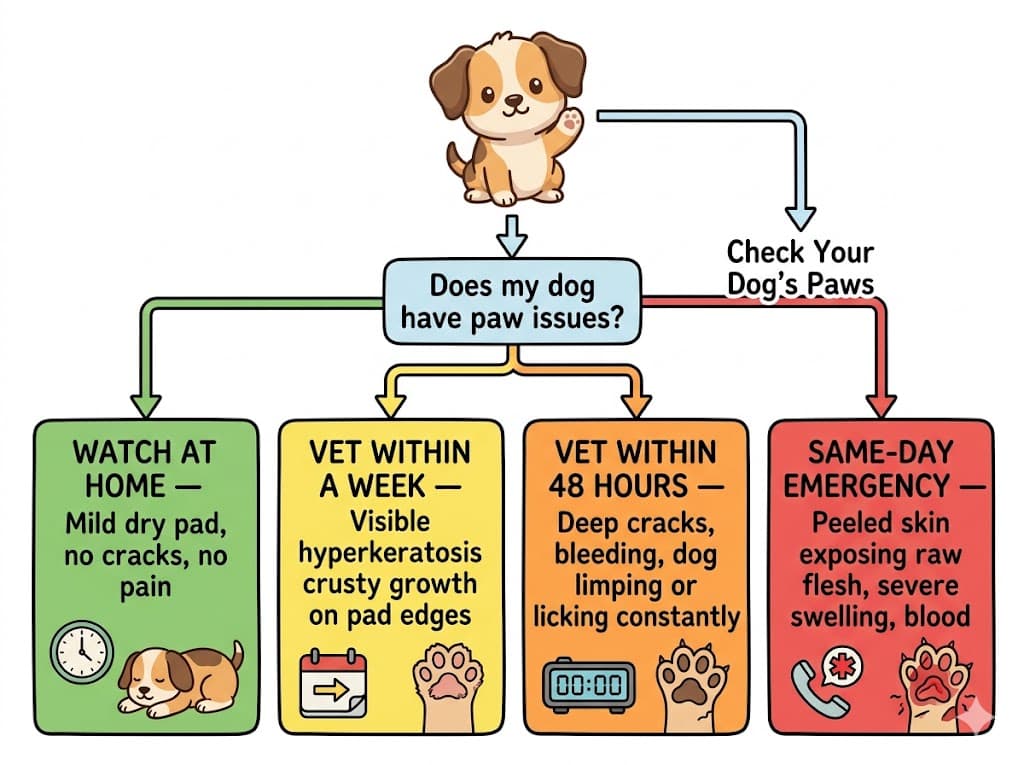
Vet visit within a week for: visible crusty growth on pad edges, deep cracks, mild limping, hyperkeratosis on both paws and nose together. Vet within 48 hours for: peeled skin exposing raw flesh anywhere on pads, scattered crusts and scales (pemphigus suspicious), red-brown patches with surface damage from recent burn exposure, significant lameness. Same-day emergency vet for: heavy bleeding from cracks, dog refusing to bear weight, infected-looking pads with pus or foul smell, peeled scales over large area exposing raw flesh.
Can I use balm or moisturizer at home for hyperkeratosis dog paw?
+
Owner-applied paw balm or moisturizer is not a substitute for vet diagnosis — and using the wrong product on an undiagnosed condition is a common reason hyperkeratosis cases drag on for months. The right move is a vet visit to identify whether the pad change is chronic hyperkeratosis, normal callus (no action needed), pemphigus (needs vet-led care, not moisturizer), or chemical burn (needs different care plan again). Only after the vet has identified the specific sub-type does a tailored paw care plan make sense.
Is hyperkeratosis dog paw genetic or environmental?
+
Hyperkeratosis dog paw can be either, depending on the dog. Idiopathic hyperkeratosis is genetic and most common in Labrador Retrievers, Cocker Spaniels, English Bulldogs, Bedlington Terriers, and Irish Terriers, often appearing in middle age. Acquired hyperkeratosis develops secondary to chronic environmental exposure, certain infections like distemper, or autoimmune conditions like pemphigus foliaceus. Your vet identifies which version is present through history-taking and sometimes a skin biopsy. For breed-specific paw care guidance see the [American Kennel Club paw care reference](https://www.akc.org/expert-advice/health/dog-paw-care/), and the [PetMD hyperkeratosis dog reference](https://www.petmd.com/dog/conditions/skin/hyperkeratosis-dogs) covers the autoimmune pemphigus look-alike pattern in detail.
Related Dog Paw Reading
Deeper guidance on dog paw conditions, licking behavior, and pad disorders — written for dog owners trying to make sense of what they see.
Why Do Dogs Lick Their Paws? 5 Hidden Causes + When to Vet
Companion guide covering the most common driver of paw irritation — allergic itch plus yeast — and how to distinguish licking-driven changes from primary hyperkeratosis.
Read more →
Dog Paw AI Photo Identification Tool
Broader tool covering all dog paw conditions beyond hyperkeratosis: red between toes, yeast infection, swelling, cuts and bleeding, and more.
Read more →
Dog Paw Yeast Infection Pictures — AI Photo Identification
Yeast Malassezia between the toes is the most common cause of chronic dog paw licking and shares some visual overlap with mild hyperkeratosis.
Read more →
As an Amazon Associate, Yipara earns from qualifying purchases — at no extra cost to you. How we handle partner links.
💡Recommended for this concern
🐾Pet care essentials worth keeping at home
More ways to check your pet
Eyes
Dogs & CatsRed, watery, cloudy, or squinting eyes? See if it's something to watch or act on.
⭐ Most Popular
Skin & coat
Dogs & CatsItchy, red, scabby, or losing fur? See if it's something to watch or act on.
Dog ears
Dogs OnlyScratching, head-shaking, or smelly ears? See if it's something to watch or act on.
Cat ears
Cats OnlyScratching, dark wax, or head-shaking? See if it's something to watch or act on.
Cat vomiting
Cats OnlyThrowing up foam, food, or bile? See if it's something to watch or act on.
Dog vomiting
Dogs OnlyThrowing up foam, bile, or food? See if it's something to watch or act on.
Dog nose
Dogs OnlyDry, cracked, crusty, or runny nose? See if it's something to watch or act on.
Dog teeth & gums
Dogs OnlyBad breath, tartar, or red gums? See if it's something to watch or act on.
Dog poop
Dogs OnlyBlood, mucus, worms, or runny stool? See if it's something to watch or act on.
Dog lumps & bumps
Dogs OnlyFound a new lump or bump? See if it's something to watch or act on.
Dog wounds
Dogs OnlyA cut, scrape, or wound that looks off? See if it's something to watch or act on.
Dog bug ID
Dogs OnlyFound a bug, flea, or tick on your dog? See if it's something to watch or act on.
Dog paws
Dogs OnlyLimping, licking, or swollen paws? See if it's something to watch or act on.
Cat pee
Cats OnlyBlood, dark, or cloudy urine? See if it's something to watch or act on.
Dog pee
Dogs OnlyBlood, dark, or orange urine? See if it's something to watch or act on.
Dog gums & tongue
Dogs OnlyPale, blue, yellow, or off-color gums? See if it's something to watch or act on.
Cat hair loss
Cats OnlyBald patches, thinning, or over-grooming? See if it's something to watch or act on.
Cat eye discharge
Cats OnlyWatery, green, yellow, or crusty eyes? See if it's something to watch or act on.
Cat sneezing + eye discharge
Cats OnlySneezing + watery, yellow, or green eyes? See if it's something to watch or act on.
Severe dog ear wax
Dogs OnlyBrown chunky wax, pus, or black mite debris? See if it's something to watch or act on.
Cat ear infection pictures
Cats OnlyYellow-green pus, brown chunky, or black debris? See if it's something to watch or act on.
Dog hot spots pictures
Dogs OnlyRed moist patch that appeared in hours? See if it's something to watch or act on.
Dog tail lump pictures
Dogs OnlyLump on the tail — cyst, lipoma, or concerning? See if it's something to watch or act on.
Cat paw infection pictures
Cats OnlyPus, brown greasy, or sudden swollen paw? See if it's something to watch or act on.
Dog ear yeast infection pictures
Dogs OnlyBrown chunky wax with sweet musty smell? See if it's something to watch or act on.
Black stuff in dogs ear
Dogs OnlyDark gritty debris, greasy brown, or pus inside ear? See if it's something to watch or act on.
Brown discharge dog ear infection
Dogs OnlyGreasy brown discharge, yellow pus, or thick gunk in ear? See if it's something to watch or act on.
Bump on dogs ear
Dogs OnlySoft cyst, cauliflower wart, red pimple, or firm polyp? See if it's something to watch or act on.
Scabs on dogs ears
Dogs OnlyDry healed, red infected with pus, or mites scratch scab? See if it's something to watch or act on.
Crusty dog ears
Dogs OnlyYellow bacterial, brown yeast, or pinnal margin edge crust? See if it's something to watch or act on.
Dog ear ticks
Dogs OnlySmall unfed, engorged, embedded, flea dirt or mites debris? See if it's something to watch or act on.
Dry dog ears
Dogs OnlySenior aging, yeast chronic, seborrhea, winter or allergy? See if it's something to watch or act on.
Cat acne pictures
Cats OnlyBlackheads, cystic bumps, or chin mites? See if it's something to watch or act on.
Dog skin diseases pictures
Dogs OnlyAllergic, bacterial, mange, ringworm, or hot spot? See if it's something to watch or act on.
Dog skin tags pictures
Dogs OnlySkin tag, tick mimic, wart, or cyst? See if it's something to watch or act on.
Dog skin infection pictures
Dogs OnlyBacterial, yeast, fungal ringworm, or hot spot? See if it's something to watch or act on.
Dog belly rash pictures
Dogs OnlyAllergy, flea, yeast in folds, or bacterial? See if it's something to watch or act on.
Dog paw yeast pictures
Dogs OnlyRust staining, corn-chip smell, bacterial, or cyst? See if it's something to watch or act on.
Hyperkeratosis cat paw
Cats OnlyCrusty pad edge, horned paw, pemphigus, or burn? See if it's something to watch or act on.
Cherry eye in cats
Cats OnlyRed rounded mass at inner eye corner? See if it's something to watch or act on.
Cat eye infection pictures
Cats OnlyRed eye, pus, watery, or single-eye discharge? See if it's something to watch or act on.
Cat cloudy eye
Cats OnlyCataract, nuclear sclerosis aging, or uveitis? See if it's something to watch or act on.
Dog ringworm pictures
Dogs OnlyCircular bald patch with scaly edge? See if it's something to watch or act on.
Dog skin black spots pictures
Dogs OnlyFlea dirt, comedones, hyperpigmentation, or Cushing's? See if it's something to watch or act on.
Dog skin scabs pictures
Dogs OnlyHot spot, allergy, mange, FAD, or injury scab? See if it's something to watch or act on.
Dog skin rash pictures
Dogs OnlyHives, atopic, food allergy, FAD, or contact rash? See if it's something to watch or act on.
Dog skin mites pictures
Dogs OnlySarcoptic, Demodex, ear mites, or Cheyletiella? See if it's something to watch or act on.
Cat skin conditions pictures
Cats OnlyAtopic, miliary, eosinophilic, ringworm, or abscess? See if it's something to watch or act on.
Cat skin tag pictures
Cats OnlySkin tag vs nipple vs tick vs wart vs cyst? See if it's something to watch or act on.
Cat skin infection pictures
Cats OnlyBacterial, fungal, yeast, mite, or scratch wound? See if it's something to watch or act on.
Cat black spots on skin
Cats OnlyLentigo vs flea dirt vs acne vs mange vs growth? See if it's something to watch or act on.
Cat skin rash pictures
Cats OnlyAllergic, FAD, fungal, miliary, or severe? See if it's something to watch or act on.
Cat skin mites pictures
Cats OnlyNotoedric, Cheyletiella, Demodex, or harvest? See if it's something to watch or act on.
Cat ringworm pictures
Cats OnlyEarly stage, classic ring, spreading, or mistaken-for? See if it's something to watch or act on.
Dog eye discharge
Dogs OnlyGreen, yellow, brown, or watery eye goop? See if it's something to watch or act on.
Dog nails
Dogs OnlyA broken, bleeding, or torn nail? See if it's something to watch or act on.
Dog weight
Dogs OnlyOverweight, underweight, or just right? See if it's something to watch or act on.
Cat weight
Cats OnlyOverweight, underweight, or just a pouch? See if it's something to watch or act on.
Dog hair loss
Dogs OnlyBald spots, patches, or thinning fur? See if it's something to watch or act on.
Cat gums & tongue
Cats OnlyPale, blue, yellow, or red gums? See if it's something to watch or act on.
Dog acne
Dogs OnlyPimples or bumps on the chin or muzzle? See if it's something to watch or act on.
Cat acne
Cats OnlyBlack specks or bumps on the chin? See if it's something to watch or act on.
Cat paws
Cats OnlySwollen, puffy, or sore paws? See if it's something to watch or act on.
Cat wounds
Cats OnlyA cut, scrape, or wound that looks off? See if it's something to watch or act on.
Cat bug ID
Cats OnlyFound a bug, flea, or tick on your cat? See if it's something to watch or act on.
Cat teeth & gums
Cats OnlyBad breath, drooling, or red gums? See if it's something to watch or act on.
Cat poop
Cats OnlyBlood, mucus, worms, or runny stool? See if it's something to watch or act on.
Cat lumps & bumps
Cats OnlyFound a new lump or bump? See if it's something to watch or act on.
Cat nose
Cats OnlyCrusty, runny, or discolored nose? See if it's something to watch or act on.

View all checks
See everything Yipara can help you check